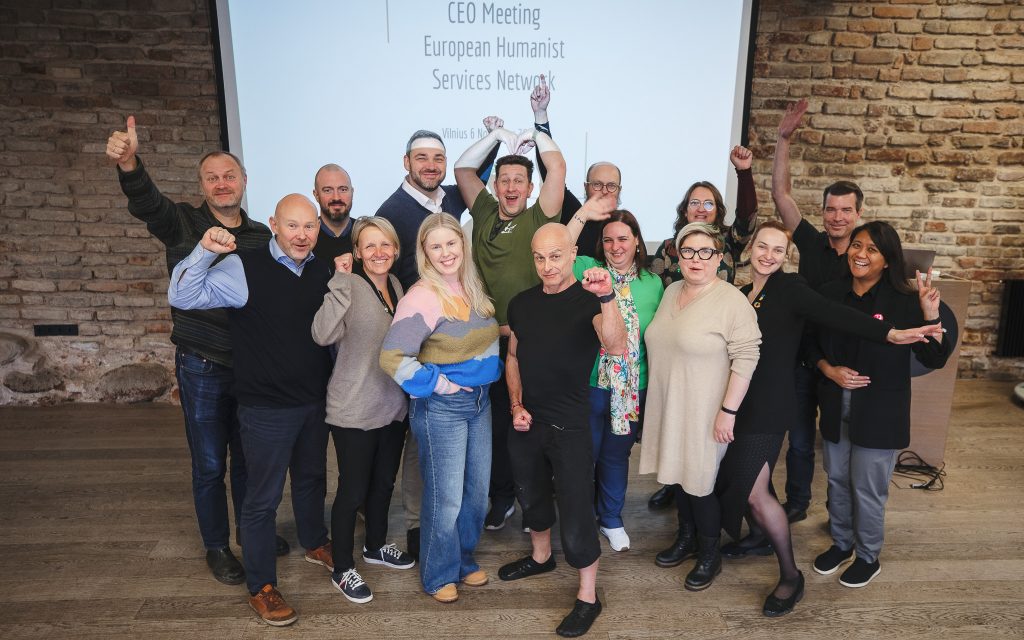
Katrin Raczynski: Dear Lone, we recently met at the CEOs’ meeting in Vilnius, and my impression was that the work within the European Humanist Services Network has become truly productive, and that it has succeeded in creating real value for the practical humanist work of the European member organizations. How was this achieved, and how would you describe the current collaboration and its key success factors?
Lone Ree Milkær: Thorough preparation and close contact with the partners is the short answer. The long answer is that it first required a lot of preparation to initiate the actual cooperation. It all started with the assumption that European cooperation on practical humanism should be possible because many organisations were doing great work, and there was an increasing focus on practical humanism across Europe. Then, for more than a year, as part of a pilot project with Humanists International, I travelled to visit numerous European organisations and talked to the rest of them. I asked what their focus was, what their practice was and what they would most like to develop, what their great successes and their greatest challenges were. This resulted in the scope of the three specific sub-projects that the networks have started cooperating on: Wedding ceremonies, humanist existential care and youth education and activities.
After the pilot, it was decided that the network would work best as an independent entity and not as a part of Humanists International. Now, the network operates as a partnership between European organisations, and sub-projects are constructed on an opt-in basis. This means that the partner organisations have signed a partnership agreement, which states their willingness to cooperate and provide direct and in-kind contributions (which could be human resources, meeting rooms, etc.) to the network. The partner organisations can then join any of the sub-projects that they find relevant. Participation in all or any sub-projects is not a demand to be a partner in the network.
A key factor in this is commitment from the top of the partner organisations. Even though you could say that the activities in the network have a solid basis in the practice of the organisations and are not desk theories of what would be nice to have, it has still been important that the sub-projects are something that is aligned with the strategies of the organisations and that the CEOs can see the purpose and benefit of entering into a European network. It is crucial for the success of the network that we have organisational support and access to sanctioned resources in the organisations. This is the only way that the in-kind contribution basis of the network can function.
The EHSN project could serve as a prototype for Humanists International when it comes to fostering national cooperation and exchange. In your view, what are the most important aspects to consider when building a supranational network?
The most important thing is to limit the scope and to have specific goals. The second most important thing is to accept that it takes time and patience to make it work. Networks do not work only on paper or in theory. People have to meet – preferably several times and in different constellations – for it to work. And we have seen a keen interest in meeting each other in the network, both at the CEO network meetings and at the working seminars where all the sub-project working groups meet. This has strengthened the network immensely.
The limit and the specificity in the cooperation come through the focus and the pretty strict control of the three sub-projects, i.e. the ceremony group has worked focused on a joint wedding standard and the online humanist wedding portal. But also that the groups are allowed to develop and suggest new goals that point towards further cooperation. The members of the group have agreed to move on to funerals, and goals have been set to agree upon a joint funeral standard.
As mentioned above, the sub-projects have grown out of a thorough research process, but they have also been constructed based on the assumption that they should cover different areas of challenges in the organisations. First, something that most organisations do very well and therefore could benefit from the development of, which is humanist ceremonies. Secondly, something that a few organisations do really well and more organisations want to be better at, which is humanist existential care (chaplaincy or pastoral care). And finally, something that no organisation does really well, but that they all want to be better at, which is youth engagement. Not all of the 20 partner organisation participates in all three sub-projects, but they are partners nonetheless.
In a partnership as EHSN, which spans from large humanist organisations with a lot of members and activities to new organisations with only a handful of active members and a wish to initiate a humanist service, it is key that the sub-projects are constructed in a way that every type of organisation can benefit from investing time and money in participating as much as possible.
Even at the national level, we often deal with different humanist strategies and emphases—roughly speaking, on a spectrum from more secular or church-critical approaches to a more cooperative or inclusive humanist self-understanding. How is it possible at the European level to integrate these different strategies into a shared working process?
Lone: From the very beginning, it has been clear that this is a network that focuses on practical humanism. This means that the organisations that have joined the network share an approach to humanism that includes some kind of practice, whether it be conducting wedding ceremonies or teaching humanism in primary school. This also means that some European organisations have not found it relevant to be part of the EHSN, and that is as it should be. The opt-in principle also means that all organisations don’t have to agree about everything.
What is planned for 2026? Which projects or initiatives do you expect to be particularly important or particularly challenging?
Lone: A group of very capable people from both partner organisations and educational institutions have been writing a joint standard for European humanist existential care, which we will be working on an accreditation scheme for at the beginning of 2026. This standard will be important for the organisations which are working towards strengthening their position as providers of existential care, as well as for the organisations that are just now developing a humanist existential care service. We’re also planning to launch a new sub-project which will focus on fundraising. Can we benefit from sharing experience and best practices, and can we cooperate on a joint international fundraising campaign?
The Youth Education and Activities sub-project has been a challenge to get up and running, and has been from the beginning. We still need to find the right format of cooperation for this part of the network. We’re working towards a summer camp in 2027 in Romania, and hopefully, that will give the sub-project the boost that is needed.
Where do you see further opportunities and potential to strengthen cooperation?
Frankly, I see nothing but potential. Of course, the development of the network is dependent on the goodwill and contribution of the partner organisations, but we have met nothing but that up until now in the cooperation. Every partner organisation values the network and the cooperation in the sub-projects.
Potentially, we can increase the areas of cooperation to include other types of humanist services, like administration and leadership in humanist organisations and institutions, marketing, or community building. And last but not least, EHSN is a platinum sponsor of the World Humanist Congress in Ottawa in August 2026. This is an opportunity to promote the European humanist wedding portal and to showcase the model network that we have managed to build in Europe in a fairly short time.
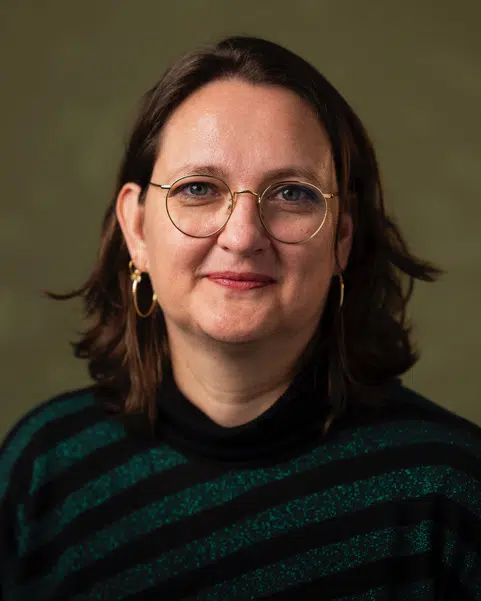
Lone Ree Milkær earned her Ph.D in Cultural Studies at the University of Bergen in Norway, having completed a Master’s degree in Folklore at the University of Copenhagen in Denmark. As an independent researcher, she specialises in interdisciplinary issues and also works as a network manager for the European Humanist Services Network. From 2014 to 2022, she served as president of the Danish Humanist Society.